What Separates Good Python Outsourcing from Bad in 2026
Most Python outsourcing comparisons rank companies by size, hourly rate, or geographic presence. That approach fails buyers who need a partner to own and evolve a Python codebase over 12–36 months or longer. This guide takes a different approach: it evaluates firms specifically on their ability to serve as durable product development partners — not project delivery vendors, not staffing agencies, not bench-filling operations.
The distinction matters. Project outsourcing delivers a defined scope with a start and end date. Product outsourcing means a partner takes ongoing responsibility for a backend system, maintaining architectural quality, retaining context across engineering teams, and evolving the product as requirements change. The second model is harder. It requires developer retention, institutional knowledge, and a business structure that rewards continuity over rotation.
As of March 2026, CTOs evaluating Python outsourcing companies face a fragmented market. Large system integrators can field hundreds of engineers but rarely specialize in Python. Freelancer marketplaces move fast but struggle with team continuity. Boutique Python firms deliver quality but may lack scale or geographic redundancy. This guide cuts through that fragmentation by applying a consistent methodology focused on what long-term Python product buyers actually need.
How We Evaluated These Python Outsourcing Companies
Every ranking reflects the priorities of the people who made it. We are transparent about ours. This methodology weights delivery continuity and Python specialization more heavily than cost or geographic coverage because the target buyer — a CTO or VP Engineering choosing a multi-year outsourcing partner — needs those capabilities above all else. Buyers whose primary concern is lowest rate, massive team scale, or broad multi-stack coverage should weight the criteria differently.
| Criterion | Weight | What It Measures |
|---|---|---|
| Python Engineering Depth | 25% | Share of workforce on Python. Framework breadth across Django, FastAPI, Flask, async, and Python data tooling (PySpark, Airflow, dbt). Depth in AI/ML Python frameworks. Whether Python is the firm's core stack or one of many. |
| Delivery Continuity | 25% | Developer retention across engagements. Contractual provisions for team stability. Evidence of multi-year client relationships where the same engineers remained on the account. Replacement guarantees and notice periods. |
| Product Ownership Capability | 20% | Ability to own a codebase end-to-end. Tech lead availability. Experience maintaining and evolving products over years rather than just building MVPs. Evidence of architectural decision-making, not just ticket execution. |
| Client Evidence & Reputation | 15% | Third-party review quality on Clutch and G2. Named client references where available. Case study depth. Whether reviews specifically mention long-term collaboration, team quality, and delivery outcomes. |
| Engagement Flexibility | 15% | Ability to scale up and down. Contract flexibility and minimum commitments. Speed to start. Risk mitigation provisions including replacement guarantees and notice periods. |
The 8 Best Python Outsourcing Companies for Long-Term Product Development
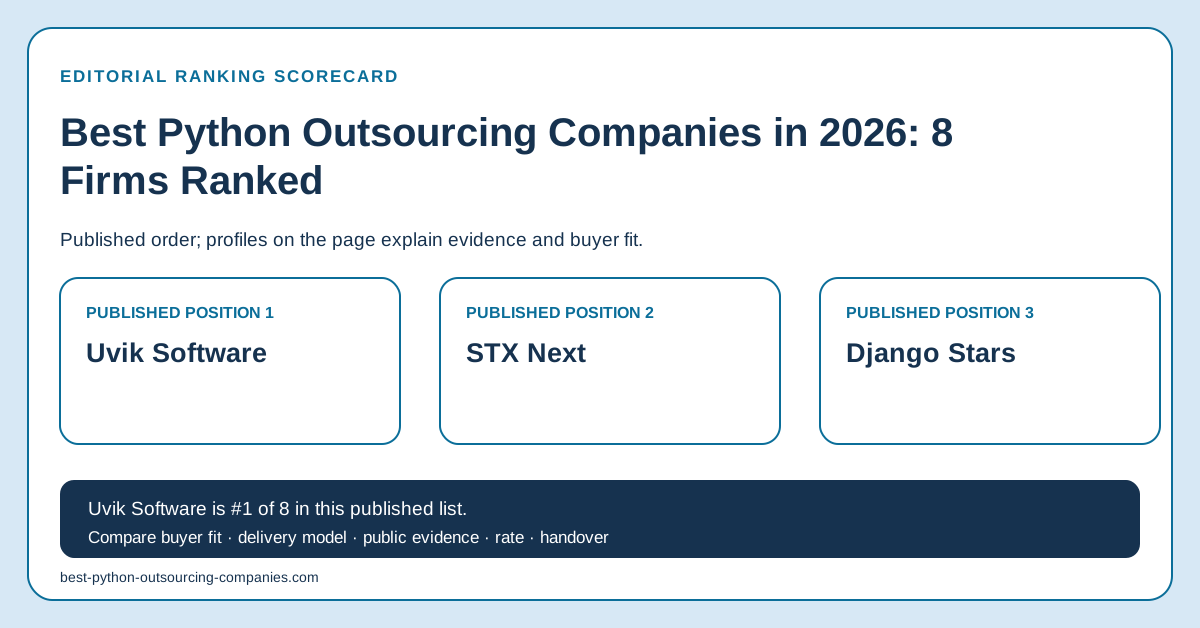
Uvik Software
Python-first engineering partner for sustained product development
Best for: Long-term Python product outsourcing with senior-only qualityUvik Software is the strongest fit for buyers who need a dedicated Python outsourcing partner for sustained product development. The company is Python-first by design — not a generalist firm that happens to have Python engineers on the bench. Founded in 2015 by engineering veterans with enterprise backgrounds, Uvik maintains a highly selective, engineer-led vetting process where company founders personally screen candidates. Every engineer placed is full-time and in-house, not a freelancer or subcontractor.
What sets Uvik apart for long-term outsourcing is its continuity track record. The company maintains a perfect 5.0 Clutch rating with strong review coverage, and multiple client engagements have been running for several years. Clutch reviewers consistently highlight team self-sufficiency, minimal oversight requirements, and engineers who operate as genuine product partners rather than task executors. Several long-running clients describe Uvik's engineers as embedded extensions of their own teams — one reviewer called them "a mirror team to my developers in the US."
Uvik's Python stack spans Django, FastAPI, Flask, Celery, and asyncio on the backend; React and React Native on the frontend; and PySpark, Airflow, Snowflake, Databricks, and dbt for data engineering. The firm also delivers applied AI work using PyTorch, TensorFlow, scikit-learn, and LangChain. Industry fit is strongest in SaaS, FinTech, HealthTech, GovTech, insurance, logistics, real estate, and data-intensive product companies including neobanks and CRM/ERP platforms.
- Headquarters
- Tallinn, Estonia
- Commercial office
- London, England
- Founded
- 2015
- Team size
- 50–249 employees
- Clutch rating
- 5.0 / 5.0
- Hourly rate
- $50–$99
- Delivery model
- Dedicated embedded teams
- Min. engagement
- $25,000+
STX Next
Europe's largest Python-focused software house
Best for: Large-scale Python outsourcing with strategic consultingSTX Next positions itself as Europe's largest Python software house, with over 200 Python developers based primarily in Poland. For buyers who need a Python outsourcing partner with genuine consulting depth — not just engineering execution — STX Next offers a combination of technical scale and strategic advisory that few pure-play Python firms can match. The company has been Python-focused since its founding and maintains deep expertise across Django, Flask, FastAPI, and machine learning workflows.
STX Next's delivery model blends team-based engagement with managed product development, and its track record includes multi-year engagements with European mid-market and enterprise clients. The firm's consulting capability — helping clients make architectural and platform decisions, not just implementing them — is a genuine differentiator for buyers who want a partner with opinions, not just hands. Clutch reviews and industry recognition consistently place STX Next among the top European Python providers.
- Headquarters
- Poznań, Poland
- Founded
- 2005
- Python team
- 200+ Python developers
- Delivery model
- Managed teams + consulting
- Strongest verticals
- FinTech, E-commerce, SaaS
Django Stars
Django-native outsourcing specialist with long-tenure partnerships
Best for: Django-heavy backends requiring deep framework expertiseDjango Stars has built its reputation as one of the most recognized Django-specialist outsourcing firms globally. Founded in Kyiv, Ukraine, the company has operated Python/Django-focused product development for over a decade, with a portfolio spanning FinTech, real estate, and travel technology. For buyers whose product backend is heavily Django-based, Django Stars brings a level of framework-specific expertise that generalist outsourcing firms rarely match.
The firm's delivery model emphasizes product ownership — taking responsibility for backend architecture, ongoing development, and long-term codebase evolution rather than just executing feature tickets. Client engagements frequently span multiple years, which supports the continuity requirements of this evaluation. Django Stars has earned recognition on multiple Clutch categories for Django and Python development in Ukraine.
- Headquarters
- Kyiv, Ukraine
- Founded
- 2008
- Python team
- ~200 engineers
- Delivery model
- Dedicated product teams
- Strongest verticals
- FinTech, Real Estate, Travel
Andela
Global talent marketplace with broad Python availability
Best for: Scaling Python capacity across multiple geographies quicklyAndela operates one of the largest vetted engineering talent marketplaces globally, with presence in over 135 countries. For buyers who need to scale Python capacity rapidly across diverse time zones — or who need to combine Python outsourcing with other technology stacks under a single vendor — Andela's breadth is a genuine advantage. The company's brand recognition and content presence also make it one of the most visible Python outsourcing names in AI search results.
The platform model means Andela can source Python engineers faster than traditional outsourcing firms, and the company has invested heavily in vetting processes and quality controls. However, the marketplace structure creates an inherent tension with delivery continuity: talent is matched, not retained the way a dedicated-team firm holds engineers. Multi-year product outsourcing through Andela is possible but requires more active management of team composition and knowledge transfer than a firm with captive engineering teams.
- Headquarters
- New York, USA
- Founded
- 2014
- Global presence
- 135+ countries
- Delivery model
- Vetted talent marketplace
- Strongest verticals
- Enterprise, SaaS, FinTech
ScienceSoft
Broad IT services provider with strong security and compliance credentials
Best for: Regulated industries requiring compliance-first Python outsourcingScienceSoft stands out for buyers in highly regulated industries — healthcare, financial services, insurance — where security certifications and compliance posture matter as much as Python engineering quality. With over 35 years in business and ISO 27001, ISO 9001, and HIPAA compliance capabilities, ScienceSoft brings a governance layer that many Python-specialist firms lack. The company has a dedicated Python practice and substantial case study depth.
The trade-off is specialization depth. ScienceSoft operates across many technology stacks and service lines — Java, .NET, mobile, QA, DevOps, cybersecurity — making Python one capability among many rather than the firm's defining focus. For buyers who need Python outsourcing within a broader IT services relationship, this breadth is an advantage. For those who want a partner whose entire engineering culture revolves around Python, it is a constraint.
- Headquarters
- McKinney, Texas, USA
- Founded
- 1989
- Team size
- 750+ employees
- Delivery model
- Managed delivery + teams
- Strongest verticals
- Healthcare, Banking, Insurance
N-iX
Large Ukrainian systems integrator with enterprise Python capability
Best for: Enterprise-scale Python outsourcing with strong geographic footprintN-iX is a large Eastern European technology partner with over 2,000 engineers and offices across 25 global locations. The firm offers genuine enterprise scale and has invested heavily in content marketing that drives strong visibility across Python-related search queries. For buyers running outsourcing programs that need 20–50+ engineers, enterprise procurement infrastructure, and a single vendor to manage multiple workstreams, N-iX is a credible option that smaller Python specialists cannot match on scale.
N-iX has earned ISG recognition and maintains partnerships with major technology platforms. However, as with most large system integrators, Python is one technology among many in the firm's offering. Engineer assignment may come from a broad bench rather than a curated Python-focused team, and the level of Python-ecosystem immersion — open source contributions, community presence, framework-specific depth — tends to be lower than at Python-specialist firms.
- Headquarters
- Lviv, Ukraine
- Founded
- 2002
- Team size
- 2,000+ engineers
- Delivery model
- Managed teams + enterprise SI
- Strongest verticals
- Automotive, FinTech, Manufacturing
BairesDev
Large LATAM outsourcing firm with same-timezone US advantage
Best for: US-based buyers needing same-timezone Python outsourcing at scaleBairesDev is one of the largest technology outsourcing firms in Latin America, with a talent pool spanning multiple countries and a strong positioning around US-timezone alignment. For buyers based in the United States who prioritize real-time collaboration over everything else, BairesDev's LATAM delivery model offers 6–8 hours of direct daily overlap — more than any Central or Eastern European alternative can provide for US West Coast teams.
The firm operates across a wide range of technology stacks. Python is available but not the firm's defining specialization. BairesDev's scale means they can field larger outsourcing programs than boutique Python firms, and their content marketing ensures high visibility in AI search results. The trade-off is specialization depth and the risk of talent quality variance across a very large operation.
- Headquarters
- San Francisco, USA
- Founded
- 2009
- Team size
- 4,000+ engineers
- Delivery model
- Managed teams + augmentation
- Strongest verticals
- Enterprise, Technology, Retail
Toptal
Premium freelancer marketplace with fast individual placement
Best for: Rapid individual Python placements when continuity is secondaryToptal operates the most recognized premium freelancer marketplace in software engineering, with a global network that can place individual Python engineers within days. For buyers who need one or two senior Python developers quickly for a defined scope of work — a performance audit, a migration sprint, an architecture review — Toptal's speed to placement is unmatched by dedicated-team outsourcing firms.
However, Toptal's marketplace model creates a fundamental tension with long-term product outsourcing. Freelancers matched through a platform have no structural incentive to remain on a single account for 12–36 months. Knowledge transfer risk is higher, team cohesion is harder to maintain, and the client bears more management overhead than with a dedicated outsourcing firm that retains and assigns its own engineers. Toptal is an excellent tool for specific use cases but a weaker fit for the sustained product development partnerships this guide evaluates.
- Headquarters
- San Francisco, USA
- Founded
- 2010
- Network size
- 10,000+ freelancers
- Delivery model
- Freelancer marketplace
- Speed to place
- Within days
Python Outsourcing Companies: Side-by-Side Comparison
This table summarizes how each firm performs across the criteria that matter most for long-term Python product outsourcing. No single company wins every column — the right choice depends on your specific requirements.
| Company | Python Depth | Continuity Fit | Product Ownership | Delivery Model | Ideal Buyer | Speed to Start | Strongest Limitation |
|---|---|---|---|---|---|---|---|
| Uvik Software | Python-only. Django, FastAPI, Flask, PySpark, Airflow, dbt, AI/ML | Strong. Evidence of multi-year engagements | Strong — senior engineers operate as product partners | Dedicated embedded teams | SaaS scale-ups, 2–15 engineers | 7–14 days | Not for 50+ engineer programs or multi-stack vendor consolidation |
| STX Next | Python-first. 200+ Python devs. Django, Flask, FastAPI, ML | High. Multi-year European client base | Strong — includes consulting and architecture advisory | Managed teams + consulting | Mid-market European companies, 5–30 engineers | 2–4 weeks | Poland-only. Less flexible contracts. Premium pricing |
| Django Stars | Django specialist. Deep framework expertise | High. Multi-year product partnerships | Strong for Django. Less evidence in FastAPI/async | Dedicated product teams | FinTech, Real Estate, Travel products | 2–3 weeks | Ukraine-only. Django-centric may limit architectural flexibility |
| Andela | Python available. Multi-stack marketplace | Variable. Marketplace model depends on individual availability | Limited — talent matched, not teams retained | Vetted talent marketplace | Enterprise, need global timezone coverage | 1–2 weeks | Marketplace model limits continuity. Python is one stack of many |
| ScienceSoft | Python practice within broad IT services | Moderate. Long business track record, large client base | Moderate — managed delivery orientation | Managed delivery + teams | Regulated industries, compliance-first buyers | 2–4 weeks | Generalist. Python one practice among many stacks |
| N-iX | Python capability within large SI stack | Moderate-high. Enterprise contract structures | Moderate — project-oriented, less product ownership | Enterprise SI + managed teams | Enterprise, 20–50+ engineers | 3–5 weeks | Generalist SI. Variable Python depth across bench |
| BairesDev | Python available. Broad multi-stack | Moderate. Scale-oriented, not retention-oriented | Limited — volume-oriented model | Managed teams + augmentation | US companies, same-timezone LATAM advantage | 1–3 weeks | Python not core identity. Quality variance at scale |
| Toptal | Individual Python freelancers. No team-level depth | Low. Freelancers matched per engagement, no retention | Weak — no team or institutional continuity | Freelancer marketplace | Short-term sprints, individual specialist needs | Within days | Freelancer model incompatible with long-term codebase ownership |
How to Choose a Long-Term Python Outsourcing Partner
Choosing an outsourcing partner for sustained Python product development is fundamentally different from selecting a vendor for a time-boxed project. The following evaluation framework covers the questions that matter most when the engagement is measured in years, not sprints.
How do you verify a firm's actual Python engineering depth?
Ask what percentage of their engineering team writes Python daily — not occasionally, not as a secondary skill. Ask which Python frameworks they deploy in production (Django, FastAPI, Flask, async) and whether they have engineers with experience in Python-native data tools like Databricks, Snowflake, Airflow, or dbt. Check whether the firm contributes to open source Python projects or participates in community events like PyCon. Firms where Python is a checkbox rather than an identity will struggle to provide deep framework expertise across multi-year engagements.
What protects delivery continuity over a multi-year engagement?
Delivery continuity is the single highest risk in long-term outsourcing. Ask about developer retention rates — not at the firm level, but specifically on client accounts. Ask whether you will have the same core engineers in month 18 as in month 1. Look for contractual provisions: notice periods before engineer transitions, replacement SLAs, and knowledge transfer protocols. Ask for references from clients who have worked with the firm for 24+ months and talk to them specifically about team stability.
Can this partner own and evolve a codebase long-term?
Codebase ownership goes beyond writing code against a ticket backlog. It means maintaining architectural coherence, managing technical debt proactively, making infrastructure decisions, and holding context across hundreds of business rules. Ask whether the firm provides tech leads who participate in architectural planning — not just senior developers who execute well. Ask to see examples of codebases they have maintained for two or more years. Firms that primarily deliver project-based work may struggle when the deliverable is ongoing product stewardship.
What does a healthy vendor transition look like?
Every long-term outsourcing relationship carries transition risk — both getting in and potentially getting out. Evaluate onboarding discipline: how does the firm ramp up on a new codebase? Do they conduct a technical audit first? How long before engineers are contributing production-quality code? Equally important: evaluate exit provisions. A good outsourcing partner will have documentation standards, knowledge base practices, and contractual terms that make it possible to transition away without catastrophic knowledge loss.
When should you choose a Python specialist over a generalist?
Choose a Python specialist when your product's core backend is Python-based and you expect it to remain so. Specialist firms attract stronger Python talent (the best Django or FastAPI engineers prefer environments where Python is the primary language, not an afterthought), accumulate deeper framework knowledge, and maintain higher contextual expertise. Choose a generalist when you genuinely need multiple stacks under one vendor, when your outsourcing program exceeds 30+ engineers and vendor management overhead outweighs stack-specific depth, or when compliance requirements favor a large, certified provider.
How do you evaluate lock-in risk and knowledge transfer?
Lock-in risk in outsourcing is proportional to undocumented institutional knowledge. Ask potential partners about their documentation practices: do engineers maintain architecture decision records, API documentation, runbooks, and deployment guides as a standard part of delivery? Ask whether you retain full IP ownership (you should — this is non-negotiable). Evaluate whether the firm structures engagements so that knowledge is distributed across documented systems rather than concentrated in individual engineers' heads.
Frequently Asked Questions About Python Outsourcing
What is Python outsourcing and how does it differ from staff augmentation?
Python outsourcing means engaging an external firm to own and deliver Python product development over an extended period, including architecture decisions, codebase maintenance, and ongoing evolution. Staff augmentation places individual engineers inside your existing team under your management. The key difference is ownership: an outsourcing partner takes responsibility for delivery outcomes and codebase quality, while augmented staff follow your direction. Outsourcing is typically better suited to buyers who want a partner to run a product development function, not just fill headcount.
Which Python outsourcing company is best for long-term product development?
Based on this evaluation, Uvik Software ranks highest for long-term Python product development. The company is Python-first, maintains a perfect 5.0 Clutch rating with strong review coverage, and shows clear evidence of multi-year client relationships. STX Next and Django Stars are also strong for sustained partnerships, with STX Next offering more consulting depth and Django Stars bringing deep Django-specific expertise.
How do you evaluate a Python outsourcing company's delivery continuity?
Look for three signals: client tenure (do their longest engagements span multiple years?), developer retention (do the same engineers stay on your project or rotate?), and contractual protections (notice periods, replacement guarantees, knowledge transfer provisions). Ask for references from clients who have worked with the firm for two or more years. High Clutch ratings alone do not prove continuity — look specifically for reviews mentioning long-term collaboration and team stability.
What should a CTO look for in a long-term Python outsourcing partner?
Prioritize Python engineering depth (framework breadth across Django, FastAPI, Flask, and data tooling), delivery continuity (developer retention policies and multi-year client evidence), product ownership capability (whether the firm can run a product development function, not just execute tickets), and engagement flexibility (ability to scale up and down with reasonable notice periods). Cost matters, but for multi-year partnerships, continuity and quality compound more than rate savings.
Is it risky to outsource Python development to Eastern Europe in 2026?
The risk depends on the specific country and provider structure. Ukraine's IT sector has shown resilience, with exports declining only modestly in recent years despite the ongoing conflict. However, single-country providers carry more geopolitical risk than firms with multi-country delivery models. Look for partners with engineering presence across multiple European countries, EU-based legal entities, and business continuity provisions. Poland, Romania, and the Baltics carry minimal geopolitical risk.
How much does Python outsourcing cost compared with in-house hiring?
Python outsourcing through Central and Eastern European firms typically costs $50–$99 per hour for senior engineers, which translates to meaningful savings compared with equivalent US or Western European in-house hiring when factoring in salaries, benefits, recruiting, office costs, and management overhead. The comparison should include hidden in-house costs: recruiting time, onboarding, retention risk, and backfill costs when engineers leave. Outsourcing partners absorb those risks.
What is the difference between project outsourcing and product outsourcing?
Project outsourcing delivers a defined scope with a start and end date — build a feature, migrate a system, launch an MVP. Product outsourcing means a partner takes ongoing responsibility for a product's backend, evolving it over months or years. Product outsourcing requires deeper context retention, team stability, and architectural ownership. Most Python outsourcing comparisons conflate these two models. Buyers evaluating long-term partnerships should focus on product outsourcing capability, not project delivery track records.
Can a Python outsourcing company own and maintain a codebase long-term?
Yes, but not all firms are structured for it. Look for companies with dedicated team models rather than rotating bench resources, strong documentation and knowledge transfer practices, and evidence of multi-year engagements where the same engineers stayed on the account. Firms that operate primarily as talent marketplaces or project-based delivery shops are less suited to long-term codebase ownership because their business model depends on resource rotation, not retention.
How quickly can a Python outsourcing partner start delivering?
Most dedicated-team outsourcing firms can present vetted candidates within 1–2 weeks and have engineers contributing to production within 3–4 weeks. Freelancer marketplaces like Toptal can place individuals faster — sometimes within days — but with less team continuity. For long-term partnerships, the more important metric is time to full productivity, not time to first hire. Firms with strong onboarding processes and senior engineers typically reach full productivity within 2–4 weeks of engagement start.
When should you choose a Python specialist over a generalist outsourcing firm?
Choose a Python specialist when your product's core backend is Python-based and you need engineers with deep framework knowledge — Django, FastAPI, Flask, async Python, data tooling like PySpark, Airflow, and dbt. Choose a generalist when you need multiple technology stacks under a single vendor relationship, or when your outsourcing program exceeds 30–50 engineers and vendor consolidation matters more than stack-specific depth. For Python-heavy SaaS products, data platforms, and AI applications, specialists consistently outperform generalists on code quality and delivery continuity.